
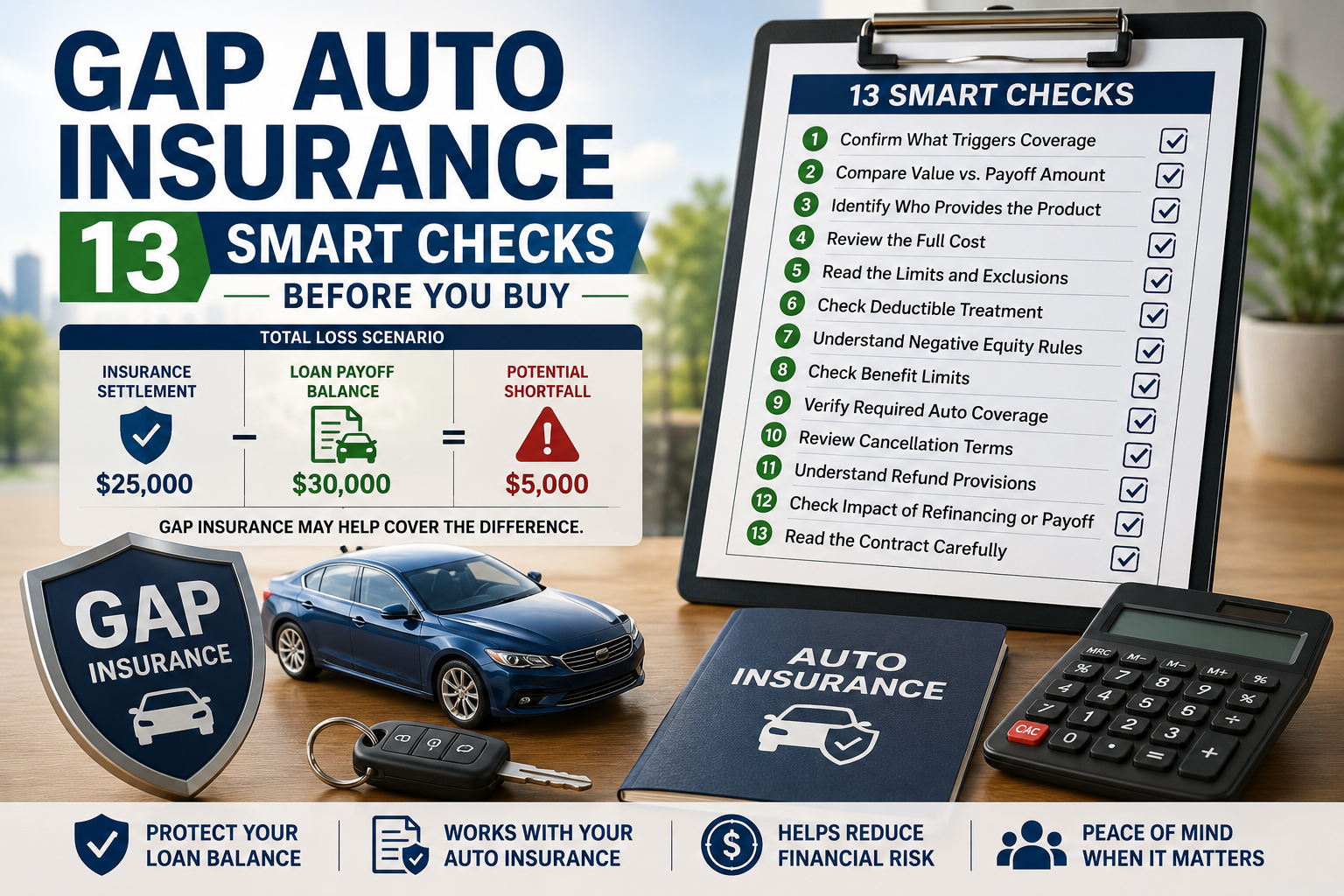
Gap auto insurance may help with one very specific financial problem: you finance or lease a vehicle, the vehicle is stolen or declared a qualifying covered total loss, and the eligible amount you still owe is higher than the primary auto insurance settlement.
For example:
Eligible loan payoff: $30,000
Covered insurance settlement: $25,000
Potential shortfall: $5,000
A qualifying GAP product may help with some or all of that eligible $5,000 difference.
But gap auto insurance does not automatically guarantee that every remaining dollar on the loan will be paid.
The actual result can depend on:
- The primary auto insurance claim
- Vehicle valuation
- Deductible
- Eligible loan balance
- Negative equity
- Financed add-ons
- Benefit limits
- Exclusions
- Payment history
- GAP contract terms
That makes gap auto insurance a product to understand and compare carefully rather than simply accepting because it appears on a dealership or financing form.
Drivers who want the shortest beginner explanation can first read what’s GAP insurance.
Educational note: VexoRatesUS.com provides general U.S. personal auto insurance education only. We are not an insurer, lender, dealer, insurance agency, broker, quote marketplace, claims service, or coverage approval service. GAP prices, eligibility, limits, exclusions, deductibles, refunds, cancellation rights, claim requirements, and state rules vary. Always review the actual auto policy, GAP agreement, loan, or lease before purchasing or relying on protection.
What Is Gap Auto Insurance?
Gap auto insurance is protection designed to address an eligible financial difference between a financed or leased vehicle’s covered total-loss settlement and the qualifying balance still owed.
The reason the difference can exist is simple.
Your auto insurer generally insures the vehicle according to the policy.
Your lender expects repayment according to the financing agreement.
Those are two different contracts.
Suppose:
Vehicle covered value: $24,000
Eligible loan payoff: $29,000
There may be a potential $5,000 shortfall.
Gap auto insurance may help address that eligible difference according to its terms.
It does not normally increase the value of the vehicle from $24,000 to $29,000.
Instead:
Primary auto insurance → handles the covered vehicle loss
GAP protection → may handle the eligible financing shortfall
1. Check Whether You Actually Need Gap Auto Insurance
Before buying gap auto insurance, check whether a meaningful financial gap exists.
Start with:
Current loan payoff
versus
reasonable vehicle value estimate
For example:
Loan payoff: $31,000
Vehicle value: $25,000
Potential negative equity: $6,000
That does not predict the exact amount an insurer or GAP provider would pay after a loss.
It simply tells you that the loan balance may currently exceed the vehicle’s value.
GAP may deserve closer consideration when you:
- Make a small down payment
- Finance most of the vehicle
- Choose a long loan term
- Lease the vehicle
- Finance a rapidly depreciating car
- Carry eligible negative equity
- Would struggle to pay an uncovered shortfall yourself
For the loan side of this calculation, see gap insurance auto loan.
2. Understand How Gap Auto Insurance Fits Into Your Auto Policy
Gap auto insurance is not a replacement for ordinary auto insurance.
Depending on the policy and state, your regular auto coverage may include:
- Liability
- Collision
- Comprehensive
- Uninsured or underinsured motorist coverage
- PIP
- Medical payments
- Other endorsements
For a qualifying total loss, collision or comprehensive coverage may handle the vehicle first.
GAP may then become relevant if the qualifying loan or lease balance remains higher than the eligible settlement.
For the full two-layer explanation, read car insurance with GAP insurance.
3. Collision Coverage and Gap Auto Insurance Are Different
Collision coverage may help with eligible damage to your vehicle after a collision or rollover.
If the vehicle is repairable, collision may help pay eligible repair costs subject to the policy and deductible.
If it is declared a covered total loss, the insurer determines the applicable settlement.
That is when gap auto insurance may become relevant.
Suppose:
Covered vehicle settlement: $23,000
Eligible loan balance: $27,000
Potential shortfall: $4,000
GAP may address an eligible portion of that difference.
It does not replace collision coverage itself.
4. Comprehensive Coverage Can Also Trigger the GAP Question
Comprehensive coverage may apply to certain eligible non-collision losses.
Depending on the policy, examples can include:
- Theft
- Fire
- Vandalism
- Hail
- Falling objects
- Flood-related loss
- Animal strikes
Imagine the financed vehicle is stolen and not recovered.
The comprehensive claim is accepted.
The insurer settles the covered vehicle loss.
If the qualifying loan balance remains higher, gap auto insurance may then be evaluated.
Again:
Comprehensive handles the eligible vehicle loss.
GAP may handle the eligible shortfall.
5. Check the Deductible
Deductibles matter.
Imagine your auto policy has a:
$1,000 collision deductible
and the vehicle is declared a covered total loss.
Will gap auto insurance pay that $1,000?
Not automatically.
Different GAP products may:
- Exclude the deductible
- Cover some of it
- Cover it up to a limit
- Treat it differently depending on the contract
Do not assume GAP means zero out-of-pocket cost.
For more detail, see what is a deductible in car insurance.
6. Check How Negative Equity Is Treated
Negative equity is central to gap auto insurance.
It means:
Amount owed > vehicle value
But not all negative equity is identical.
Suppose you owe $5,000 more than your old vehicle is worth.
You trade it in.
That $5,000 is added to the financing for the replacement vehicle.
Now the new loan contains debt from the old vehicle.
Will GAP cover that entire $5,000 if the replacement vehicle is later totaled?
Not necessarily.
Some products may:
- Cover part of prior negative equity
- Apply a percentage limit
- Apply a loan-to-value restriction
- Exclude some prior debt entirely
Check the written agreement.
7. Check Which Financed Add-Ons Are Excluded
A vehicle loan can contain much more than the vehicle purchase price.
Financed amounts may include:
- Taxes
- Registration
- Service contracts
- Extended warranties
- Tire or wheel products
- Accessories
- Appearance packages
- Prior debt
- GAP itself
That creates an important distinction:
Full lender payoff
is not always the same as
eligible GAP balance.
A driver can therefore purchase gap auto insurance and still owe money after a claim if some financed charges are excluded.
This is one reason to read the definition of eligible indebtedness carefully.
8. Check the Maximum Benefit
Some GAP products contain benefit limits.
These may take the form of:
- Maximum dollar amount
- Percentage of vehicle value
- Loan-to-value limit
- Contract formula
- Another specified cap
Suppose the eligible financial shortfall is:
$9,000
but the GAP agreement limits the applicable benefit below that amount.
The borrower may remain responsible for the remainder.
The cheapest gap auto insurance product is therefore not necessarily the strongest.
Compare price and protection together.
9. Compare Where You Buy Gap Auto Insurance
GAP protection may be available from different sources.
Potential sources include:
- Auto insurer
- Dealership
- Lender
- Credit union
- Leasing company
- Other eligible provider
These products can differ.
An auto insurer may offer GAP as an endorsement or policy option.
A dealership or lender may offer a separate GAP waiver or debt-cancellation product.
Compare:
- Product type
- Price
- Duration
- Benefit limit
- Deductible treatment
- Negative-equity rules
- Exclusions
- Cancellation
- Refunds
Do not assume products are identical simply because they use the word GAP.
10. Check the Total Gap Auto Insurance Cost
The complete cost matters more than the monthly-payment increase.
Imagine a dealership offers GAP for:
$600
If you pay $600 directly, the basic price is clear.
If that $600 is added to a multi-year auto loan, you can potentially pay interest on it as well.
The real cost then becomes:
GAP price + financing cost
rather than simply $600.
Drivers comparing costs should read how much is GAP insurance.
It focuses specifically on insurer pricing, dealership costs, financing, cancellation, and refunds.
11. Check Whether Gap Auto Insurance Is Optional
For most ordinary vehicle-financing situations, GAP is generally an optional add-on rather than normal state-required personal auto insurance.
A financing or leasing contract can contain separate requirements.
If someone tells you that you must purchase gap auto insurance, ask:
Where does the written financing or lease agreement say that?
Do not confuse:
State-required auto insurance
with
Lender requirements
with
Optional GAP protection
They are different issues.
12. Check Cancellation and Refund Rules
The financial gap can disappear before the loan ends.
Consider:
Earlier
Loan payoff: $29,000
Vehicle value: $24,000
Potential negative equity: $5,000
Later
Loan payoff: $19,000
Vehicle value: $22,000
The simplified negative-equity gap has disappeared.
At that point, gap auto insurance may provide much less practical benefit.
Depending on the product and situation, cancellation may be possible.
A refund may potentially be:
- Full
- Partial
- Prorated
- Subject to specific conditions
Check the agreement.
Do not assume the provider automatically cancels GAP when positive equity develops.
13. Read the Gap Auto Insurance Contract Before Buying
This is the most important rule.
Before buying gap auto insurance, find the sections covering:
- Eligible vehicles
- Eligible loans or leases
- Total-loss requirements
- Vehicle valuation
- Eligible balance
- Benefit limit
- Deductible treatment
- Negative equity
- Financed add-ons
- Required collision and comprehensive coverage
- Exclusions
- Claims
- Cancellation
- Refunds
- Coverage end date
Do not rely solely on:
- Sales pitch
- Advertisement
- Monthly-payment presentation
- Product name
- Verbal promise
The written agreement controls.
Gap Auto Insurance From an Auto Insurer
Some auto insurance companies offer qualifying customers GAP-related protection directly through the policy.
This can have advantages.
For example, the driver may have:
- Regular auto policy
- Collision and comprehensive
- GAP-related endorsement
through the same insurer.
That can make policy administration simpler.
However, availability and eligibility vary.
The insurer may impose requirements involving:
- Vehicle age
- Vehicle purchase date
- Original ownership
- Loan or lease
- Collision and comprehensive coverage
- Policy status
Compare the actual wording before assuming insurer-based gap auto insurance is better than another product.
Gap Auto Insurance From a Dealer
Dealership GAP products can be offered during the vehicle transaction.
The product may be added alongside:
- Extended warranty
- Service contract
- Tire protection
- Appearance products
- Other add-ons
Do not judge it by the change in monthly payment.
Ask for:
- Separate GAP price
- Contract
- Benefit limit
- Exclusions
- Financing cost
- Cancellation terms
- Refund terms
Then compare it with other available GAP options.
Gap Auto Insurance From a Lender or Credit Union
Banks, credit unions, and other lenders may also offer GAP protection.
Again, contract structure varies.
Ask whether the product:
- Is insurance
- Is a waiver
- Is debt cancellation
- Has a maximum payment
- Covers deductibles
- Includes negative equity
- Can be cancelled
- Provides refunds
The provider matters less than the actual written protection.
Gap Auto Insurance for a New Vehicle
Newer vehicles can depreciate quickly.
A driver who finances nearly the full purchase price can therefore develop negative equity early.
Imagine:
Vehicle purchase price: $40,000
Down payment: $2,000
A large percentage of the purchase remains financed.
If vehicle value falls rapidly, the amount owed may exceed the vehicle’s value.
This is one common situation where gap auto insurance deserves investigation.
Gap Auto Insurance for a Used Vehicle
Some used vehicles can qualify for GAP.
Others may not.
Eligibility can depend on:
- Vehicle age
- Mileage
- Purchase date
- Loan age
- Vehicle value
- Loan-to-value ratio
- Provider rules
Do not assume GAP is unavailable simply because the vehicle is used.
Likewise, do not assume every used vehicle qualifies.
Check first.
Gap Auto Insurance for a Leased Vehicle
Some leases include GAP protection or a similar waiver already.
Before paying separately for gap auto insurance, check the lease agreement.
Look for:
- GAP
- Guaranteed Asset Protection
- Total-loss waiver
- Lease shortfall
- Early-termination provisions
Buying duplicate protection may add cost without creating an extra payment.
Gap Auto Insurance With a Small Down Payment
A small down payment leaves more of the purchase price financed.
That can increase early negative-equity exposure.
Example:
Vehicle price: $36,000
Down payment: $1,000
Amount financed begins close to the original vehicle price.
If the vehicle’s value falls quickly, the financial gap can become significant.
Gap Auto Insurance With a Large Down Payment
A large down payment can reduce the potential shortfall.
Example:
Vehicle price: $36,000
Down payment: $10,000
The initial financing balance is considerably lower.
This may shorten or eliminate the period when the balance exceeds vehicle value.
It does not automatically mean GAP is unnecessary.
It means the actual gap should be measured.
Gap Auto Insurance and Long Auto Loans
Long auto loans can increase the time a driver remains in negative equity.
Examples include:
- 72-month financing
- 84-month financing
Long terms can cause the principal balance to decline relatively slowly.
Combine that with rapid vehicle depreciation and the negative-equity period may last longer.
That makes the loan-to-value relationship worth reviewing.
What Happens After a Total Loss?
A gap auto insurance claim may involve several steps.
Step 1: Primary Auto Claim
Report the loss to your auto insurer.
Step 2: Coverage Decision
The insurer determines whether the loss is covered.
Step 3: Total-Loss Decision
The insurer determines whether the vehicle is a total loss.
Step 4: Vehicle Settlement
The eligible settlement is calculated according to the auto policy.
Step 5: Loan Payoff
The lender provides the payoff amount.
Step 6: GAP Claim
The GAP provider evaluates the eligible difference.
It may request:
- Insurance settlement
- Vehicle valuation
- Loan agreement
- Payoff statement
- Payment history
- GAP agreement
- Deductible information
- Total-loss documentation
Step 7: Eligible Benefit
The provider calculates any eligible GAP payment according to the agreement.
Simple Gap Auto Insurance Example
Consider:
Eligible loan payoff: $32,000
Insurance settlement: $27,000
Potential difference: $5,000
A qualifying GAP product may address some or all of that difference.
But now suppose the financing includes:
- $750 late payments
- $1,250 prior vehicle debt
- $500 excluded add-on
If those amounts are not eligible, the GAP payment may be less than $5,000.
The driver could still owe money.
That is why gap auto insurance should never be described as an unconditional loan-payoff guarantee.
What Gap Auto Insurance Does Not Replace
Liability Coverage
Liability generally helps with eligible injuries or property damage the insured driver becomes legally responsible for causing.
See car insurance liability coverage for more detail.
Collision Coverage
Collision generally addresses eligible vehicle damage after a collision or rollover.
Comprehensive Coverage
Comprehensive generally addresses certain eligible non-collision vehicle losses.
Mechanical Breakdown Protection
This deals with certain mechanical failures, not a financing shortfall after a total loss.
Credit Insurance
Credit insurance can address loan payments in certain circumstances such as disability, unemployment, or death depending on the product.
GAP performs a different function.
Gap Auto Insurance vs. Gap Auto Coverage
The phrases can sound almost identical.
On VexoRatesUS, the roles are intentionally separated.
Our gap auto coverage guide focuses primarily on the decision to buy, keep, review, or remove GAP protection.
This gap auto insurance article focuses on the insurance-product side:
- How GAP is offered
- Where you can buy it
- How it coordinates with the auto policy
- Contract structure
- Claims
- Exclusions
- Cancellation
- Refunds
That keeps the two pages useful without making them duplicates.
When Gap Auto Insurance May Make Sense
GAP may deserve closer consideration when:
- Loan balance exceeds vehicle value
- Down payment was small
- Loan term is long
- Vehicle depreciates quickly
- Vehicle is leased
- Eligible negative equity exists
- You could not comfortably pay a large remaining shortfall
These are reasons to investigate.
They do not automatically mean GAP should be purchased.
When Gap Auto Insurance May Be Less Useful
GAP may provide less value when:
- Vehicle is owned outright
- Loan payoff is below vehicle value
- Large down payment created positive equity
- Loan is almost paid off
- Similar protection already exists
- Potential shortfall is small
- Vehicle no longer qualifies
Periodically check the actual numbers.
Common Gap Auto Insurance Mistakes
Assuming GAP Pays the Full Loan
It may only pay an eligible difference.
Assuming GAP Replaces Normal Insurance
It does not.
Ignoring the Deductible
Check the contract.
Ignoring Negative Equity Rules
Prior debt may be restricted.
Financing GAP Without Checking Total Cost
Interest can increase the eventual price.
Buying Duplicate Protection
Check the lease, loan, and auto policy first.
Letting Collision or Comprehensive Lapse
The underlying vehicle claim may be essential.
Keeping GAP After the Gap Is Gone
Review cancellation and refunds.
Reading the Agreement Only After a Claim
Read it before buying.
Gap Auto Insurance Comparison Checklist
When comparing products, review:
| Check | Option A | Option B | Option C |
|---|---|---|---|
| Provider | Check | Check | Check |
| Product type | Compare | Compare | Compare |
| Total price | Compare | Compare | Compare |
| Financing cost | Compare | Compare | Compare |
| Benefit limit | Compare | Compare | Compare |
| Eligible loan balance | Check | Check | Check |
| Deductible treatment | Check | Check | Check |
| Negative equity rules | Check | Check | Check |
| Required auto coverage | Check | Check | Check |
| Cancellation | Compare | Compare | Compare |
| Refund provisions | Compare | Compare | Compare |
If you are also comparing the underlying auto policies, use compare auto insurance quotes so the liability limits, collision and comprehensive deductibles, drivers, vehicles, and optional coverage match.
Questions to Ask Before Buying
Ask:
- Who provides the gap auto insurance?
- Is the product insurance, a waiver, or debt cancellation?
- What does it cost?
- Will the cost be financed?
- Which total-loss events qualify?
- Which loan or lease balance is eligible?
- Is there a maximum benefit?
- How is the deductible treated?
- How is negative equity treated?
- Which financed add-ons are excluded?
- Must collision and comprehensive remain active?
- What happens after refinancing?
- When does the coverage end?
- Can I cancel it?
- Could I receive a refund?
- What documents are required for a claim?
Frequently Asked Questions
What Is Gap Auto Insurance?
Gap auto insurance is protection intended to help with an eligible difference between a financed or leased vehicle’s covered total-loss settlement and the qualifying amount still owed.
Is Gap Auto Insurance Required by Law?
GAP is generally an optional add-on rather than ordinary state-mandated personal auto insurance.
A financing or leasing agreement can contain separate contractual requirements.
Does Gap Auto Insurance Replace Collision and Comprehensive?
No.
GAP generally depends on an eligible underlying vehicle insurance settlement.
Does Gap Auto Insurance Cover Repairs?
Generally no.
GAP is designed around qualifying total-loss situations rather than normal vehicle repairs.
Does Gap Auto Insurance Cover the Deductible?
Possibly.
Treatment varies according to the agreement.
Does Gap Auto Insurance Cover Negative Equity?
Some products may cover qualifying negative equity subject to limits.
Other amounts may be restricted or excluded.
Can I Get Gap Auto Insurance From My Insurer?
Some insurers offer GAP-related protection to qualifying policyholders.
Availability and requirements vary.
Can I Buy Gap Auto Insurance Later?
Some providers allow later enrollment when eligibility rules are satisfied.
Others restrict when it can be purchased.
Can Gap Auto Insurance Be Cancelled?
Some GAP products can be cancelled.
Refund rights depend on the agreement and circumstances.
What Happens to GAP if I Refinance?
Refinancing can terminate or otherwise affect existing protection.
Check before refinancing.
Final Takeaway
Gap auto insurance is designed around one specific risk:
Your qualifying loan or lease balance remains higher than the covered insurance settlement after a qualifying total loss.
Before buying, check:
- Vehicle value
- Loan payoff
- Eligible balance
- Primary auto coverage
- Deductible
- Negative equity
- Benefit limits
- Exclusions
- Total GAP cost
- Financing cost
- Cancellation
- Refunds
The kid-simple rule is:
Check what you owe.
Check what the car is worth.
Check what GAP actually covers.
Check the price.
Then decide.
Helpful Authoritative Resources
- Consumer Financial Protection Bureau — Guaranteed Asset Protection (GAP) insurance — Federal consumer guidance explaining GAP, auto-loan balances, costs, optional add-ons, cancellation, and possible refunds.
- Consumer Financial Protection Bureau — auto insurance options when financing a car — Federal guidance about GAP and other insurance products associated with financed vehicles.
- Federal Trade Commission — financing or leasing a car — Federal consumer guidance about auto financing, dealership add-ons, total cost, and contract review.
- National Association of Insurance Commissioners — state insurance departments — Directory for locating the appropriate state insurance regulator.
Author Bio
VexoRatesUS Editorial Team
VexoRatesUS.com provides educational information about U.S. personal auto insurance, including gap auto insurance, GAP coverage, vehicle financing, collision and comprehensive coverage, liability protection, deductibles, policy limits, premiums, loans, leases, and insurance comparison.
Our goal is to help U.S. drivers understand insurance and financing products clearly before making coverage decisions.
Copyright Notice
© 2026 VexoRatesUS. All rights reserved.
This article about gap auto insurance is protected by copyright and may not be copied, scraped, spun, republished, or commercially reproduced without prior written permission from VexoRatesUS.
Brief quotations may be used with clear attribution and a link to the original article.
Unauthorized reuse of this content, including AI rewriting, automated spinning, bulk scraping, or republication, is prohibited.
Disclaimer
This gap auto insurance article is provided for general educational purposes for people living in the United States.
It is not personalized insurance, financial, lending, legal, tax, claims, or underwriting advice.
It does not guarantee GAP eligibility, coverage, loan payoff, claim approval, cancellation, refund, savings, vehicle valuation, settlement, or any financial result.
Auto insurance requirements, GAP agreements, policy terms, exclusions, deductibles, benefit limits, negative-equity treatment, financing costs, lender requirements, cancellation rights, refund provisions, eligibility rules, insurer practices, and state requirements vary.
This article does not replace the actual personal auto policy, declarations page, GAP agreement, debt-waiver agreement, financing contract, lease, lender requirements, endorsement, exclusion, or other controlling document.
Review all applicable documents carefully before purchasing, financing, cancelling, refinancing, or relying on gap auto insurance.