
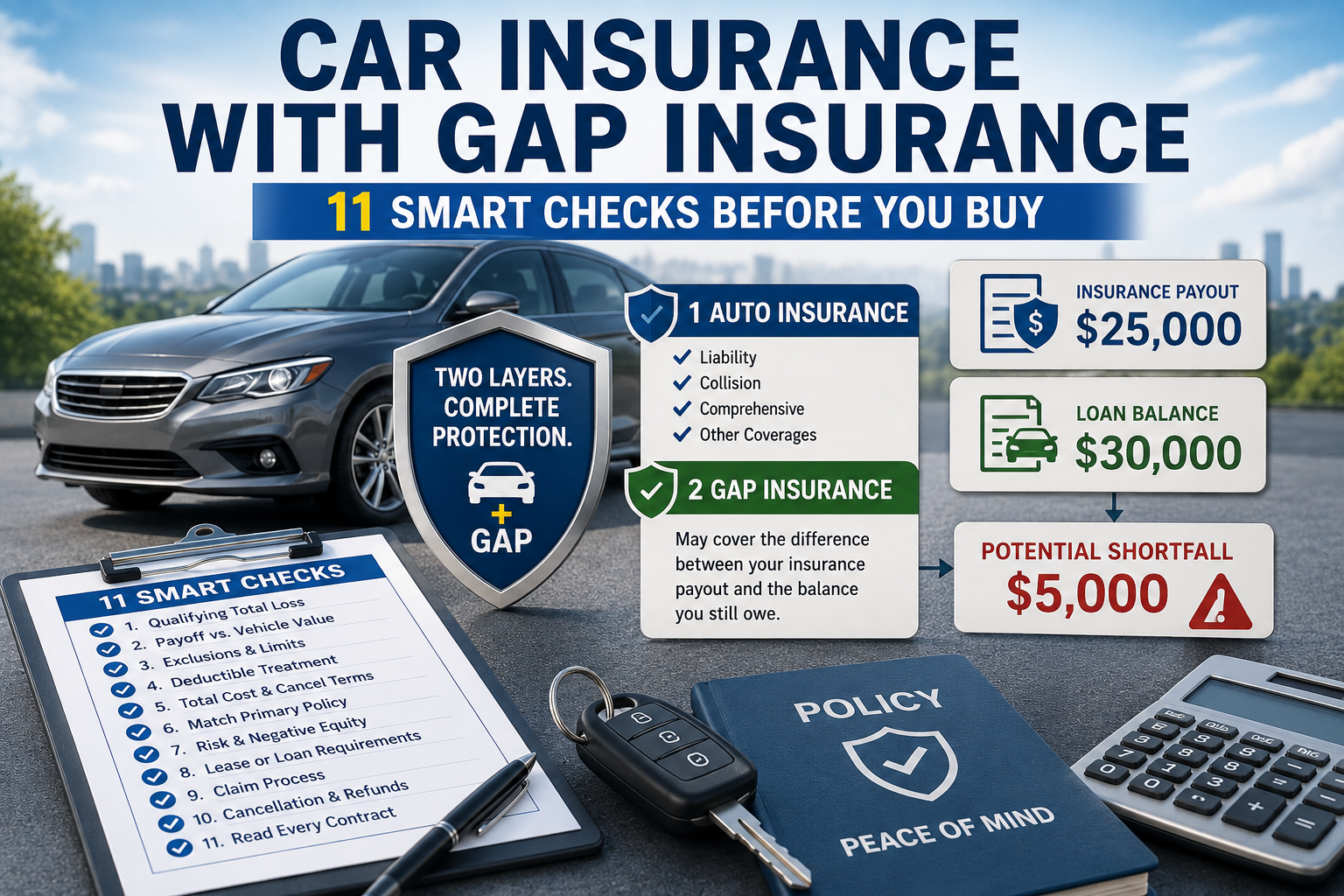
The regular auto insurance policy generally handles the insured vehicle loss first.
GAP protection may then help with an eligible difference between the covered insurance settlement and the qualifying amount still owed on the vehicle.
For example:
Eligible loan payoff: $30,000
Covered insurance settlement: $25,000
Potential gap: $5,000
A qualifying GAP product may help address some or all of that eligible $5,000 difference.
But car insurance with gap insurance does not automatically guarantee complete repayment of an auto loan.
Deductibles, negative equity, financed add-ons, late payments, benefit limits, exclusions, policy requirements, and the actual GAP agreement can change the result.
The simplest way to understand the combination is:
Auto insurance → protects against eligible insured losses
GAP protection → may address an eligible financing shortfall after a qualifying total loss
For the broadest explanation of GAP itself, see our gap insurance pillar.
Educational note: VexoRatesUS.com provides general U.S. personal auto insurance education only. We are not an insurer, lender, dealership, insurance agency, broker, quote marketplace, claims service, or coverage approval service. Insurance and GAP terms, eligibility, limits, exclusions, deductibles, prices, refunds, loan treatment, and state requirements vary. Always review the actual auto policy, GAP agreement, financing contract, or lease.
What Is Car Insurance With Gap Insurance?
Car insurance with gap insurance means having ordinary auto insurance protection together with GAP protection for an eligible financing shortfall.
The two products perform different jobs.
A personal auto policy may contain:
- Liability coverage
- Collision coverage
- Comprehensive coverage
- Uninsured and underinsured motorist coverage
- Personal Injury Protection where applicable
- Medical payments coverage where applicable
- Other optional endorsements
GAP generally focuses on something much narrower.
It may become relevant when:
- The insured vehicle is stolen or declared a qualifying total loss.
- The primary insurer evaluates and pays the eligible vehicle claim.
- The qualifying loan or lease balance is higher than that settlement.
- An eligible financial shortfall remains.
That is where GAP may come in.
1. Understand Which Coverage Responds First
The first important rule about car insurance with gap insurance is that the normal auto policy generally comes first.
Suppose a financed vehicle is severely damaged in a collision.
The auto insurer considers:
- Whether the loss is covered
- Whether collision coverage applies
- Whether the vehicle is repairable
- Whether it qualifies as a total loss
- The covered vehicle value
- The applicable deductible
- Policy exclusions and conditions
Only after the primary vehicle claim is evaluated can the potential GAP amount usually be determined.
GAP does not normally replace that first insurance layer.
2. Collision Coverage and GAP Do Different Jobs
Collision coverage may help with eligible damage to the insured vehicle resulting from:
- Collision with another vehicle
- Collision with another object
- Rollover
If the vehicle can be repaired, collision coverage may address eligible repair costs subject to the policy and deductible.
If the vehicle is declared a covered total loss, the insurer determines the settlement according to the policy.
That is when car insurance with gap insurance may become particularly important.
If the qualifying loan payoff exceeds the eligible settlement, GAP may then address part of the remaining difference.
GAP is therefore not collision insurance.
It sits behind it.
3. Comprehensive Coverage Can Also Connect With GAP
Comprehensive coverage generally addresses certain eligible losses that are not ordinary collisions.
Depending on the policy, examples may include:
- Theft
- Fire
- Vandalism
- Hail
- Falling objects
- Certain storm damage
- Flood-related losses
- Animal strikes
Imagine a financed vehicle is stolen and not recovered.
If comprehensive coverage applies and the vehicle is treated as a covered total loss, the primary insurer may issue a settlement.
If the qualifying loan balance remains higher, car insurance with gap insurance may provide the second layer.
Again:
Comprehensive → eligible vehicle loss
GAP → eligible financing shortfall
4. Gap Insurance Does Not Replace Liability Coverage
Liability coverage performs a completely different job.
It generally helps with covered bodily injury or property damage the insured driver becomes legally responsible for causing to other people.
GAP generally does not pay another driver’s:
- Medical bills
- Vehicle repairs
- Property damage
- Liability claim
- Legal damages
A driver purchasing car insurance with gap insurance still needs to understand the normal liability protection required or selected under the auto policy.
For more detail, see our car insurance liability coverage guide.
5. Compare the Loan Payoff With the Vehicle Value
The financial reason for buying GAP usually comes down to two numbers:
Loan payoff
and
vehicle value
Suppose:
Loan payoff: $32,000
Covered vehicle value: $27,000
There is a potential $5,000 difference before considering the GAP agreement.
This condition is commonly described as negative equity.
Negative equity can develop when a driver:
- Makes a small down payment
- Finances most of the purchase price
- Uses a long loan term
- Owns a rapidly depreciating vehicle
- Finances optional products
- Rolls previous vehicle debt into the new loan
Our gap insurance auto loan guide goes deeper into the loan side of this calculation.
6. Check What the GAP Agreement Calls an Eligible Balance
This is one of the biggest traps with car insurance with gap insurance.
A lender’s payoff amount is not necessarily identical to the balance recognized by the GAP contract.
The total loan can potentially contain:
- Vehicle price
- Taxes
- Registration fees
- Service contracts
- Extended warranties
- Accessories
- Dealer products
- Prior negative equity
- Late fees
- Missed payments
The GAP agreement may exclude some of these amounts.
That means:
Loan payoff = $31,000
does not automatically mean:
Eligible GAP balance = $31,000
Read the definition of the eligible debt carefully.
7. Check How the Deductible Works
Suppose the vehicle is totaled and the primary auto policy carries a:
$1,000 collision deductible
Will GAP cover that amount?
It depends.
Some GAP products may:
- Exclude the deductible
- Address part of it
- Cover it up to a specified limit
- Treat it differently depending on the contract
This matters because car insurance with gap insurance involves two agreements that may calculate the loss differently.
Never assume GAP automatically eliminates the auto insurance deductible.
For a deeper explanation, see what is a deductible in car insurance.
8. Keep Required Physical-Damage Coverage Active
Financed or leased vehicles commonly come with requirements concerning collision and comprehensive coverage.
The GAP agreement may also require qualifying physical-damage protection to remain active.
That means a driver should be extremely careful before cancelling:
- Collision
- Comprehensive
- Required lender coverage
If the normal auto policy does not cover the underlying loss, GAP may not provide the intended second layer.
Car insurance with gap insurance works best when both contracts are understood and kept in compliance.
9. Compare the Cost of Both Layers
Drivers should separate the price of the regular policy from the price of GAP.
The auto insurance premium can reflect factors such as:
- Driver history
- Claims
- Vehicle
- Location
- Mileage
- Household drivers
- Coverage limits
- Deductibles
- Vehicle use
- Discounts
GAP may have its own separate pricing structure.
It may be offered through:
- Auto insurer
- Dealer
- Lender
- Credit union
- Other eligible provider
A dealership or lender GAP product may be added to the vehicle financing.
If so, the borrower can potentially pay interest on the GAP charge.
Drivers focusing on price can use our how much is gap insurance guide.
10. Check Cancellation and Refund Rights
The financial gap may disappear before the auto loan ends.
For example:
Earlier
Loan payoff: $30,000
Vehicle value: $25,000
Potential negative equity: $5,000
Later
Loan payoff: $20,000
Vehicle value: $23,000
The simplified gap has disappeared.
At that stage, GAP may provide much less practical value.
A driver with car insurance with gap insurance should therefore periodically review:
- Current loan payoff
- Approximate vehicle value
- Cancellation procedure
- Possible refund
- Refinancing rules
- Coverage end date
Do not assume GAP automatically cancels.
11. Read Both Contracts Before Buying
This is the most important check.
With car insurance with gap insurance, there are potentially two different controlling documents:
Auto Insurance Policy
Check:
- Collision
- Comprehensive
- Deductibles
- Total-loss provisions
- Vehicle use
- Exclusions
- Claim requirements
GAP Agreement
Check:
- Eligible loan balance
- Covered total-loss events
- Benefit limits
- Negative-equity treatment
- Deductible treatment
- Excluded financed items
- Required underlying insurance
- Cancellation
- Refunds
- Claim documentation
Do not rely on a short sales explanation.
Read both.
How Car Insurance With Gap Insurance Works After a Total Loss
Here is the basic process.
Step 1: Report the Loss
The driver reports the accident, theft, or other covered event to the regular auto insurer.
Step 2: Primary Insurer Evaluates the Vehicle
The insurer determines:
- Whether coverage applies
- Whether the vehicle is a total loss
- Vehicle valuation
- Applicable deductible
- Settlement amount
Step 3: Obtain the Loan Payoff
The lender provides the current payoff amount.
Step 4: Compare Settlement and Eligible Balance
Suppose:
Insurance settlement: $25,000
Eligible loan balance: $30,000
Potential shortfall: $5,000
Step 5: GAP Provider Reviews the Claim
The GAP provider may request:
- Insurance settlement
- Valuation report
- Loan agreement
- Payoff statement
- Payment history
- GAP agreement
- Deductible information
- Other required documents
Step 6: Eligible GAP Benefit Is Calculated
The contract determines whether some or all of the eligible shortfall qualifies.
This is how car insurance with gap insurance functions as two connected layers rather than one single coverage.
Car Insurance With Gap Insurance for a New Vehicle
A newer financed vehicle can lose value relatively quickly.
A small down payment can make the early loan balance especially important.
For example:
Vehicle purchase price: $40,000
Down payment: $2,000
The borrower finances most of the purchase.
If the vehicle depreciates quickly, the loan balance may exceed the vehicle value during the early ownership period.
That can make GAP worth investigating.
It does not automatically mean buying GAP is necessary.
Check the actual numbers.
Car Insurance With Gap Insurance for a Long Auto Loan
Long financing terms can slow the pace at which the principal balance falls.
A driver using a:
- 72-month loan
- 84-month loan
- Other long financing term
may remain in negative equity longer.
That increases the importance of understanding the relationship between the loan and vehicle value.
Again, the decision should be based on the actual financial gap rather than the loan length alone.
Car Insurance With Gap Insurance for a Leased Vehicle
Lease contracts may already contain GAP protection or a similar waiver.
Before buying additional GAP, check the lease agreement.
Look for terms involving:
- GAP
- Guaranteed Asset Protection
- Total-loss waiver
- Lease shortfall
- Early termination
Duplicate protection can add cost without necessarily providing an additional payment.
What Happens if the Auto Policy Claim Is Denied?
This is important.
Suppose a driver has car insurance with gap insurance, but the primary auto insurer denies the vehicle claim because the loss is excluded under the policy.
The GAP agreement may not independently turn that denied loss into a covered GAP claim.
Possible issues could involve:
- Excluded vehicle use
- Policy lapse
- Material misrepresentation
- Uncovered loss
- Failure to maintain required coverage
The exact contracts control.
This is another reason the primary auto policy matters just as much as the GAP product.
What Happens if the Insurance Settlement Exceeds the Loan?
Imagine:
Insurance settlement: $27,000
Loan payoff: $22,000
There is no negative-equity shortfall in this simplified example.
GAP is designed to deal with a gap.
It is not normally an additional bonus payment simply because a vehicle was totaled.
That is why car insurance with gap insurance becomes less useful as positive vehicle equity develops.
Does GAP Pay Negative Equity From an Old Vehicle?
Not always.
Suppose a driver trades in a vehicle while owing $4,000 more than it is worth.
That $4,000 is added to the new auto loan.
The new loan now contains prior vehicle debt.
Some GAP agreements may limit how much prior negative equity qualifies.
Others may exclude it.
Get the answer in writing before buying.
Does GAP Cover Financed Add-Ons?
Again, not automatically.
A vehicle loan could contain:
- Extended warranty
- Service contract
- Tire protection
- Appearance products
- Accessories
- Other dealer add-ons
A GAP provider may exclude some of those financed costs when determining the eligible balance.
This means a borrower can still owe money after a GAP claim even though the product worked according to its contract.
Is Car Insurance With Gap Insurance Required?
Ordinary state auto insurance requirements and GAP are separate issues.
GAP is generally an optional add-on in most standard auto-loan situations.
A loan or lease agreement may contain its own contractual requirements.
If someone says GAP is mandatory, ask where that requirement appears in the written agreement.
Do not confuse:
State insurance law
with
Lender requirements
with
Optional GAP protection.
Can Gap Insurance Be Purchased From the Auto Insurer?
Some auto insurers offer qualifying customers GAP-related protection as an endorsement or optional policy feature.
Availability varies.
Other sources can include:
- Dealership
- Lender
- Credit union
- Separate eligible provider
Compare:
- Total cost
- Coverage duration
- Benefit limit
- Deductible treatment
- Negative-equity rules
- Cancellation
- Refunds
The cheapest product is not automatically the strongest one.
Can Gap Insurance Be Added Later?
Some providers may allow GAP to be added after the vehicle has already been purchased or financed.
Others impose:
- Vehicle-age restrictions
- Purchase-date restrictions
- Loan-age restrictions
- Loan-to-value limits
- Mileage rules
If you expect to add GAP later, confirm eligibility rather than assuming it will remain available.
Can Gap Insurance Be Cancelled?
Some GAP products can be cancelled.
A driver may reconsider GAP after:
- Loan payoff
- Vehicle sale
- Refinancing
- Building positive equity
- Changing coverage
Possible refunds vary.
They may be:
- Full
- Partial
- Prorated
- Subject to contract conditions
Keep written proof of cancellation requests and refund calculations.
Common Car Insurance With Gap Insurance Mistakes
Assuming GAP Replaces Collision and Comprehensive
It does not.
Assuming GAP Pays the Entire Loan
It may only pay an eligible shortfall.
Ignoring the Deductible
The GAP contract determines its treatment.
Ignoring Negative Equity
Prior vehicle debt may be limited.
Financing GAP Without Checking Total Cost
Interest may increase the eventual price.
Buying Duplicate Protection
Check the loan, lease, and insurance policy.
Letting Physical-Damage Coverage Lapse
That can create major problems.
Assuming Every Total Loss Produces a GAP Payment
There must generally be an eligible shortfall.
Forgetting to Review GAP Later
Negative equity can disappear.
Car Insurance With Gap Insurance Comparison Checklist
Before choosing coverage, compare:
| Check | Option A | Option B | Option C |
|---|---|---|---|
| Collision coverage | Match | Match | Match |
| Collision deductible | Match | Match | Match |
| Comprehensive coverage | Match | Match | Match |
| Comprehensive deductible | Match | Match | Match |
| GAP provider | Check | Check | Check |
| GAP total cost | Compare | Compare | Compare |
| Benefit limit | Compare | Compare | Compare |
| Negative equity | Check | Check | Check |
| Deductible treatment | Check | Check | Check |
| Cancellation | Compare | Compare | Compare |
| Refund rules | Compare | Compare | Compare |
For the broader policy-comparison process, see compare auto insurance quotes.
Questions to Ask Before Buying
Before choosing car insurance with gap insurance, ask:
- What does my regular auto policy cover?
- Which collision deductible applies?
- Which comprehensive deductible applies?
- Who provides the GAP protection?
- What total-loss events qualify?
- Which loan or lease balance is eligible?
- Is prior negative equity covered?
- Which financed add-ons are excluded?
- Is there a maximum GAP benefit?
- How is the deductible treated?
- Must collision and comprehensive remain active?
- What is the complete GAP cost?
- Is the GAP charge being financed?
- When does GAP coverage end?
- Can it be cancelled?
- Could a refund apply?
- What documents are required for a claim?
Frequently Asked Questions
What Is Car Insurance With Gap Insurance?
Car insurance with gap insurance combines ordinary auto insurance with separate protection that may help address an eligible financing shortfall after a qualifying total loss.
Does GAP Replace Regular Car Insurance?
No.
GAP is designed for a financing shortfall and does not replace liability, collision, comprehensive, or other required auto insurance.
Does Gap Insurance Pay for Repairs?
Generally no.
Routine or repairable vehicle damage is handled through applicable auto insurance coverage.
Does Gap Insurance Pay the Full Auto Loan?
Not necessarily.
Eligible balances, exclusions, benefit limits, deductibles, negative equity, and financed charges can affect the GAP payment.
Does Gap Insurance Cover the Deductible?
It depends on the specific GAP agreement.
Do I Need Collision and Comprehensive With GAP?
Financed vehicles and GAP products commonly require qualifying physical-damage coverage to remain active.
Review the lender and GAP documents.
Is GAP Required by Law?
GAP is generally not ordinary state-mandated personal auto insurance.
Loan and lease contracts can contain separate requirements.
Can I Cancel GAP Later?
Some products allow cancellation and may provide a refund depending on the contract and circumstances.
What Happens to GAP if I Refinance?
Refinancing can terminate or otherwise affect GAP protection.
Check before refinancing.
When Does GAP Stop Being Useful?
Its practical value generally declines when the loan payoff falls below the vehicle’s value and no meaningful negative-equity shortfall remains.
Final Takeaway
Car insurance with gap insurance involves two different protections working in sequence.
The regular auto policy generally handles the eligible vehicle loss first.
GAP may then help with a qualifying financing difference.
Before buying, check:
- Collision coverage
- Comprehensive coverage
- Deductibles
- Vehicle value
- Loan payoff
- Negative equity
- Eligible loan balance
- GAP benefit limit
- GAP exclusions
- GAP cost
- Cancellation
- Refunds
The kid-simple rule is:
Auto insurance protects the vehicle loss.
GAP protects an eligible loan shortfall.
Check both contracts.
Then decide.
Helpful Authoritative Resources
- Consumer Financial Protection Bureau — Guaranteed Asset Protection (GAP) insurance — Federal consumer information explaining GAP and the relationship between auto-loan balances and insurance settlements.
- Consumer Financial Protection Bureau — auto insurance options when financing a car — Federal guidance about insurance products connected with financed vehicles, including GAP.
- Federal Trade Commission — financing or leasing a car — Federal consumer guidance about vehicle financing, optional add-ons, contract review, and total financing costs.
- National Association of Insurance Commissioners — state insurance departments — Directory for finding the appropriate state insurance regulator.
Author Bio
VexoRatesUS Editorial Team
VexoRatesUS.com provides educational information about U.S. personal auto insurance, including car insurance with GAP insurance, collision and comprehensive coverage, auto loans, GAP protection, liability coverage, deductibles, policy limits, premiums, and quote comparison.
Our goal is to help U.S. drivers understand how different insurance and financing protections work together before making coverage decisions.
Copyright Notice
© 2026 VexoRatesUS. All rights reserved.
This article about car insurance with gap insurance is protected by copyright and may not be copied, scraped, spun, republished, or commercially reproduced without prior written permission from VexoRatesUS.
Brief quotations may be used with clear attribution and a link to the original article.
Unauthorized reuse of this content, including AI rewriting, automated spinning, bulk scraping, or republication, is prohibited.
Disclaimer
This car insurance with gap insurance article is provided for general educational purposes for people living in the United States.
It is not personalized insurance, financial, lending, legal, tax, claims, or underwriting advice.
It does not guarantee GAP eligibility, insurance coverage, loan payoff, claim approval, cancellation, refund, savings, vehicle valuation, settlement, or any financial result.
Auto insurance requirements, GAP terms, exclusions, deductibles, benefit limits, negative-equity treatment, financing costs, lender requirements, cancellation rights, refund provisions, insurer practices, and state requirements vary.
This article does not replace the actual personal auto policy, declarations page, GAP agreement, financing contract, lease, lender requirements, endorsement, exclusion, or other controlling document.
Review all applicable documents carefully before purchasing, financing, cancelling, refinancing, or relying on car insurance with gap insurance.